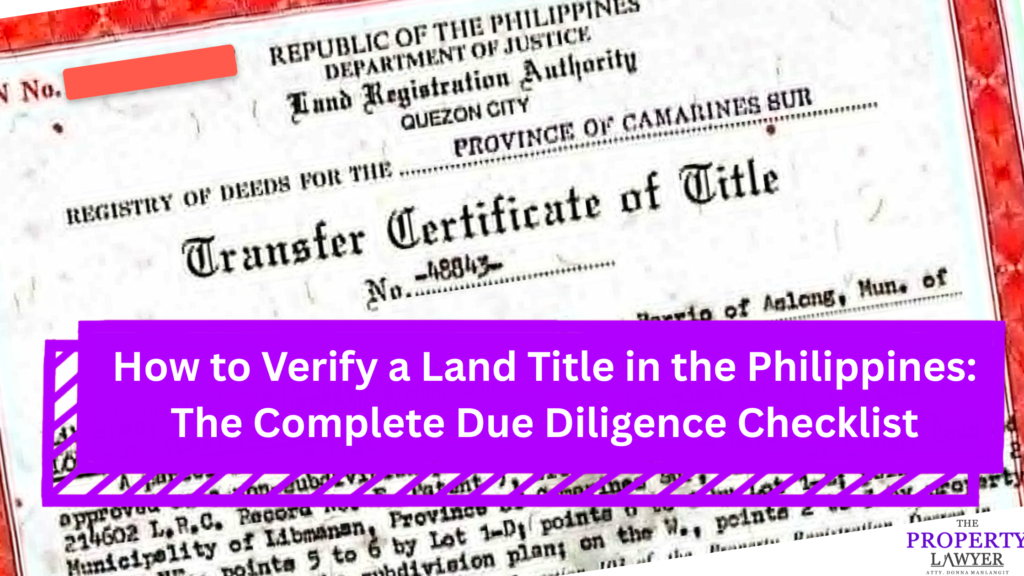
Ask the Registry of Deeds that covers the property for a CTC, then compare the lot number, boundaries, and owner’s name against the seller’s Owner’s Duplicate Copy line by line.
Don’t rush this part.
If anything doesn’t match, pause and ask the seller to explain. For a condo unit, request the CTC of the CCT.
The back page of the CTC shows the annotations, which are notes about anything already attached to the property.
Look for mortgages, adverse claims, notices of levy, and any lis pendens, the formal notice of a pending court case on the property.
Don’t let the terms scare you.
Each one can stop or complicate a transfer, so ask the seller to clear it before any money moves and to confirm the clearance in writing.
Request a certified copy of the tax declaration from the City or Municipal Assessor’s Office, and a real property tax clearance from the Local Treasurer’s Office.
The clearance is your proof that the amilyar, or real property tax, has been paid. The owner’s name and the property description on the tax declaration should also match the title.
Small differences matter.
A tax declaration supports a title but can’t replace one. It’s an easy mix-up.
The Supreme Court has held that tax declarations and tax receipts alone aren’t conclusive evidence of ownership, and that a registered title prevails over them, in Heirs of Delfin v. Rabadon (G.R. No. 165014).
Property Lawyer Tip: If a seller offers only a tax declaration, and there’s no title to verify yet, pause and ask why.
Check the seller’s government-issued ID against the name on the title.
When an agent, broker, or relative signs for the owner, ask for a notarized Special Power of Attorney (SPA) signed by the registered owner that names the property and grants the power to sell. An SPA doesn’t transfer ownership.
The place of signing matters too.
An SPA signed abroad must be apostilled or consularized before it can be registered, according to LRA Circular No. 09-2020, which lists the documents needed to register an SPA on registered land.
If the registered owner has passed away, the heirs need to settle the estate before anyone can sell.
Visit the lot and compare it with the technical description in the title and the survey plan.
Take your time walking the boundaries. The boundary markers, called muhon, should be where the survey plan puts them, and anyone living on the lot, including informal settlers, should be someone the seller told you about.
You can do this from abroad. Ask a trusted relative, a broker, or a lawyer to go in your place, and request dated photos of every boundary marker and each neighboring lot before you agree to anything.
Our guide to property inspection tips covers what to look for on site.
Zoning is its own question. A clean title doesn’t tell you whether the zone allows the house, shop, or resort you plan to build, and our guide to zoning classification in the Philippines explains how to check.

Pause if you see these. Some warning signs appear before you check a single document, and each of these is worth stopping for until the seller explains it to you in writing.
Say a lot in Batangas is listed at less than half of what the neighbors are asking, and the seller wants a reservation fee by Friday.
After years of working abroad, a bargain can feel like a reward. It’s an understandable feeling. Slow down and ask why the price is so low, because double sales and fraud syndicates lean on low prices to attract buyers.
Suppose a seller sends clear photos of the title but says the Registry of Deeds is too far away, so you should just trust the copy. A refusal to let you inspect the land, visit the Registry of Deeds, or see a clear copy of the title is worth taking seriously.
A seller with a clean title has little reason to say no. Trust your instincts here.
Consider a farm lot titled under an Emancipation Patent (EP) or a Certificate of Land Ownership Award (CLOA), and a seller who says it can be sold like any other lot.
Lands awarded under agrarian reform carry government restrictions on transfer, so a private sale needs extra clearances before it can go through. Ask before you pay.
Imagine a title issued to the current owner only recently, with nobody able to say who held the land before.
Tracing back at least 3 previous titles shows you what the newest paper leaves out, including broken chains of ownership, cancelled titles that resurfaced, and old claims that never made it onto the title.
Maybe the deposit has already gone out, and now something doesn’t feel right. Take a breath.
Philippine law sets time limits for many property claims, and how long you have depends on the type of claim, so it’s wise to get things checked sooner rather than later.
Pause further payments for now. Request a CTC of the title you were sold and compare it with your copies, then keep every receipt, message, and document in one folder so a property lawyer can see the whole story.
You can start from home. The LRA eSerbisyo portal has a Request for Certified True Copy function, and each request is filed per Registry of Deeds, so you choose the office that holds the title.
Distance doesn’t stop the rest. A trusted representative can visit the Assessor’s Office, the Treasurer’s Office, and the lot for you, and Atty. Donna Manlangit-Mattingley can go over what they collect with you by video.
Clients have booked these consultations from the Middle East, the US, and Europe without needing to set foot in the Philippines.
You’ve already done a lot by learning what to check. Titles are hard to read alone. A property lawyer fills in the gaps: what each entry on the back page means for your purchase, whether the SPA really lets the seller sell, and whether the earlier titles hold together.
For buyers abroad, there’s one more benefit. You get someone who reviews the Philippine documents for you, so the decision no longer rests on the seller’s word, an agent’s photos, or a well-meaning relative’s advice.
Preparation helps. Send a copy of the title, any deed or draft contract, and your messages with the seller or agent ahead of time, so Atty. Donna Manlangit-Mattingley can study your case before the call.