
Real Estate Guide for OFWs: How to Buy, Inherit, or Sell Land From Abroad Written by Atty. Donna Manlangit-Mattingley, Philippine lawyer and licensed real estate broker A nurse in Riyadh reached out to me about a lot she found online. The seller sounded friendly, but she couldn’t walk into the Registry of Deeds to check anything herself, and her remittance was already set aside for the deposit. Where does she start? As a licensed lawyer and real estate broker, I hear from Overseas Filipino Workers (OFWs) in 3 different situations: buying land, receiving a share of an inheritance, or selling property from abroad. Each follows its own process. Quick Summary: Real Estate for OFWs If you’re buying or selling from abroad, a Special Power of Attorney (SPA) lets a trusted representative act for you in the Philippines, with your signature apostilled or consularized. Before you send a deposit, get a fresh Certified True Copy (CTC) of the title, trace back at least 3 previous titles, and confirm the lot has legal road access. If you’re inheriting, you can settle the estate from abroad without court when there’s no will and every heir agrees, through an Extrajudicial Settlement of Estate (EJS). Sellers usually pay 6% Capital Gains Tax, buyers usually pay 1.5% Documentary Stamp Tax plus transfer tax, and heirs pay 6% estate tax. Not sure which situation fits you? Book a consultation with The Property Lawyer and I’ll go through your documents with you so you know what to send and what to hold off on signing. Who Can Own Land in the Philippines From Abroad If you’re still a Filipino citizen, you keep the full right to own land, and moving to another country for work doesn’t change that, even if you’ve been away for 20 years. Your right stays the same abroad. The rules change if you took another citizenship and lost your Filipino one. I have a client who moved to Canada years ago and became a Canadian citizen. Batas Pambansa Blg. 185 and Republic Act 8179 limit how much land a former Filipino can hold, and the cap differs for residential and agricultural land. Confirm which cap applies to you before you pay a reservation fee. It’s worth checking early. Republic Act 9225, known as the Dual Citizenship Law, lets you reacquire Filipino citizenship, and once you do, the size caps no longer apply to the land you buy. Here’s what I’d do first. Check your status before you start looking at lots. How to Buy Land From Abroad Appoint an Attorney-in-Fact You Trust Someone has to go in your place. Since you can’t be at the Registry of Deeds yourself, you appoint someone you trust to act for you, and that person is called your attorney-in-fact. The document that gives them authority is a Special Power of Attorney, usually shortened to SPA. It’s natural to feel uneasy. Your SPA should spell out exactly what your representative can do, such as signing the contract, paying taxes, and applying for a loan on your behalf. The narrower the list, the less room there is for misuse. An SPA lets someone act for you, but it doesn’t transfer ownership, so the title still has to end up in your name through a Deed of Sale. Keep that in mind. After you sign, get the SPA authenticated. If your country is part of the Apostille Convention, you get an apostille stamp, and if it isn’t, the Philippine Embassy or consulate there consularizes the document instead. This is best when done early. Verify the Title Before You Send Money There was an electrician in Doha. He found a lot in Batangas on a Facebook listing, the seller sends photos of the title, and the price looks fair. I’d hold off on wiring anything, because a photo of a title won’t tell you if the seller really owns the land or if a bank already has a claim on it. You may plan to visit the lot when you’re home next year, and a friend who’s a lawyer may have offered to look at the papers before you pay anything. Good idea. Inspecting the lot in person helps, but most of the paperwork can be checked before you ever board the plane. Here’s my list. I’d ask the seller for each of these items, then confirm each one directly with the Registry of Deeds and the local government office before I sent a single peso. A fresh Certified True Copy (CTC) of the title from the Registry of Deeds. Request it yourself or through your representative, because a photocopy from the seller can hide annotations and old claims. The previous titles, traced back at least 3 owners. A clean-looking current title can sit on top of a broken chain of ownership, with fake documents or claims that never carried over. The latest Tax Declaration and the receipts for real property tax. Gaps in the receipts mean unpaid taxes, which you want settled before the sale and not after. Proof that the lot has legal access to a public road, such as a barangay road. Landlocked lots exist, and arguing with a neighbor over access after you’ve already paid is a bad place to be. The zoning classification of the lot, which tells you what you’re allowed to build or farm on it. My post on zoning classification in the Philippines explains how to read it. Have your representative walk the lot and compare what they see with the technical description on the title, including the boundaries and the lot size stated there. My property inspection tips post gives you a checklist for the visit. Photos from the visit help too. If anything about the title looks off, read how to spot fake land titles in the Philippines and how to verify a land title in the Philippines before you decide anything. Then bring in a lawyer to review the full set of documents. Ask what the review covers. Think Twice
Estate Tax in the Philippines, the Complete Guide for Heirs
Estate Tax in the Philippines, the Complete Guide for Heirs Written by Atty. Donna Manlangit-Mattingley, Philippine lawyer and licensed real estate broker A client approached me with a house and lot in Laguna that was still titled in her late mother’s name. Her siblings wanted to sell. The buyer’s lawyer had asked for an Electronic Certificate Authorizing Registration (eCAR), and nobody in the family knew what it was, who issues it, or what it would really cost. As a licensed lawyer and real estate broker, I hear from heirs and overseas Filipinos in this spot all the time. The tax itself is a flat 6% of the net estate. The paperwork around it is often what delays a family. This guide covers the rate, the deductions, the deadline, the penalties and the Bureau of Internal Revenue (BIR) requirements, and it tells you where the estate tax amnesty stands today. Every scenario here is a composite. Quick Summary: Estate Tax in the Philippines Estate tax is a one-time national tax on passing a deceased person’s property to the heirs. For deaths on or after January 1, 2018, it’s a flat 6% of the net estate, after a ₱5,000,000 standard deduction and other deductions. The return is due within 1 year of death. Late filing adds a 25% surcharge (50% for willful neglect or fraud) plus 12% interest a year. Without an eCAR from the BIR, the Registry of Deeds won’t register the transfer to the heirs. The estate tax amnesty closed on June 14, 2025. Bills to reopen it until December 31, 2028 are still pending in Congress. Not sure which rules apply? Book a consultation with The Property Lawyer and I’ll go through your documents with you, so you know which numbers, deadlines and forms fit your situation. What Is Estate Tax in the Philippines? Estate tax is a one-time national tax on passing a deceased person’s property to their heirs. You pay it to the BIR, based on what the person owned on the day they died. Dates matter. The law in force on the date of death decides the rate and the deductions, which can make a big difference when the death happened many years ago. Who Pays and What Counts as the Estate For example, your father may have worked in Riyadh and left savings there, plus a lot in Pangasinan. Both count. A Filipino citizen or resident is taxed on property worldwide, so the Riyadh savings and the Pangasinan lot both land in his estate, wherever each one sits. A nonresident alien is taxed only on property located in the Philippines. The estate owes the tax, and the heirs deal with the BIR on its behalf. Settling it comes first. Your family usually can’t sell, mortgage or transfer what was left until the BIR has signed off on the estate and issued the papers that go with it. How to Compute Estate Tax in the Philippines For deaths on or after January 1, 2018, the Tax Reform for Acceleration and Inclusion (TRAIN) Law, Republic Act No. 10963, sets a flat 6% rate on the net estate. The computation takes 3 steps: Add up everything the person owned at death. Lawyers call this the gross estate. Subtract the deductions the law allows. Multiply what’s left, the net estate, by 6%. Estate Tax Calculator in the Philippines, Worked by Hand I’ve had clients ask whether they can get a rough number before committing to anything. You can. The arithmetic fits on a napkin. For example, take a widowed father who leaves a lot in Batangas valued at ₱7,000,000 and ₱1,000,000 in the bank, with no debts, and the lot isn’t the family home. Step Amount Gross estate ₱8,000,000 Less standard deduction ₱5,000,000 Net estate ₱3,000,000 Estate tax at 6% ₱180,000 I made these figures up to show the arithmetic, so please don’t treat ₱180,000 as an estimate for your own family, whose property, debts and deductions will look different. Real property is usually valued at the higher of the BIR zonal value and the assessor’s fair market value. An old tax declaration may show a lower number than the one the BIR uses. Online calculators run on the same formula. Pro Tip: Ask a lawyer or an accountant to check the result before you pay. Estate Tax Exemption in the Philippines and What Heirs Can Deduct People search for an estate tax exemption, but the law doesn’t exempt estates outright. Here’s how it works. It lets you subtract certain amounts from the gross estate before the 6% applies, and the table below shows the ones I look at first when a family brings me a title. Deduction Amount Standard deduction for citizens and residents ₱5,000,000, with no receipts needed Standard deduction for nonresident aliens ₱500,000 Family home Fair market value or ₱10,000,000, whichever is lower Claims against the estate and unpaid mortgages The actual amount, with proof Property inherited earlier and already taxed The vanishing deduction, within the limits the law sets Funeral, medical and judicial expenses used to be deductible. Not anymore. The TRAIN Law removed them, so please don’t plan on subtracting the hospital bills or the cost of the wake from the gross estate before you apply the 6%. Even when the math comes to zero, you still need the BIR to issue the eCAR before the title can move. When One Spouse Is Still Alive Take a family where the mother died and left a house and lot, and the father is still living. Start with who owns what. Half of the property a couple built during the marriage usually belongs to the surviving spouse from the start, so only the mother’s share goes into her estate. Her share then passes to the father and the children as heirs. I’d put the title and the marriage details in front of a lawyer before computing anything, because the couple’s property regime decides who owns what. Estate Tax Deadline in the Philippines The BIR expects
How to Spot Fake Land Titles in the Philippines: 3 Red Flags
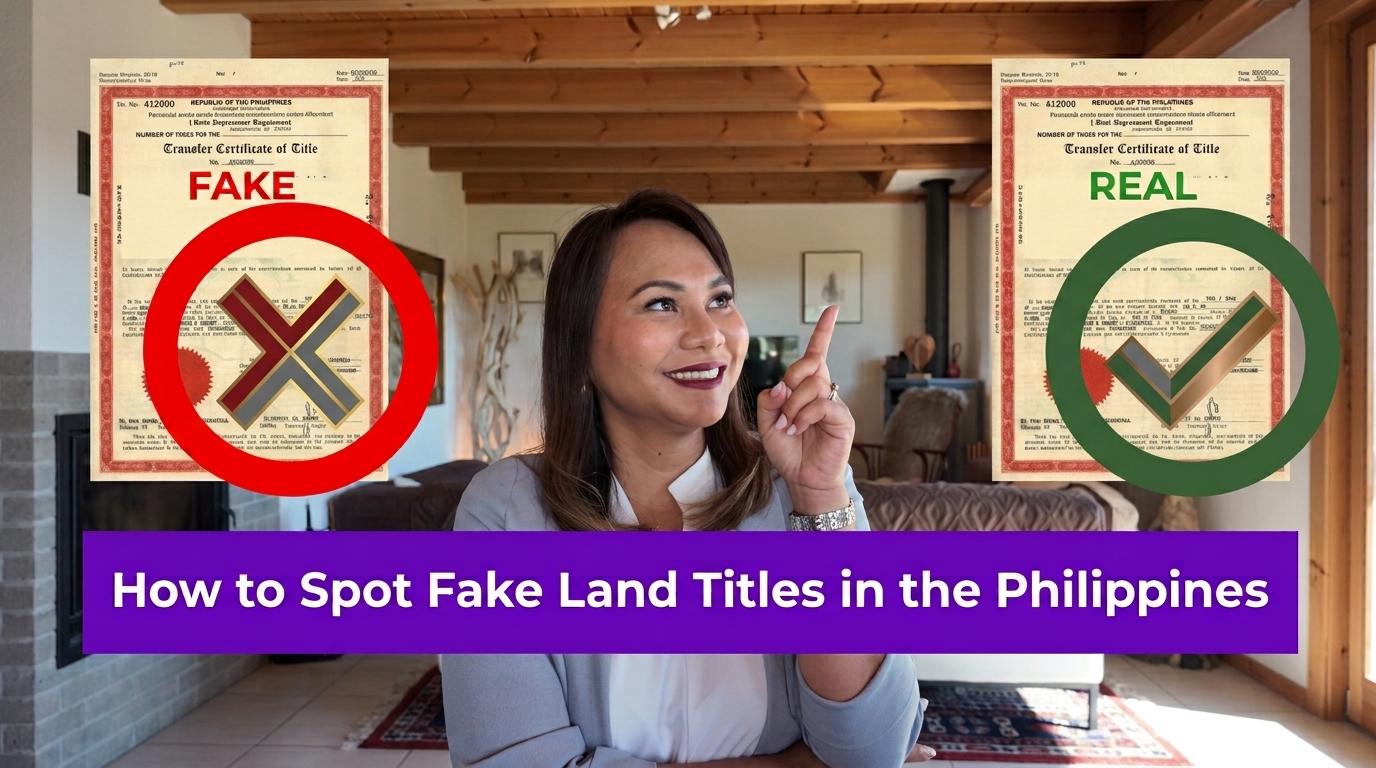
How to Spot Fake Land Titles in the Philippines: 3 Red Flags Written by Atty. Donna Manlangit-Mattingley, Philippine lawyer and licensed real estate broker A fake title can look flawless. Fake land titles in the Philippines can imitate a real Transfer Certificate of Title (TCT) so closely that a buyer who only studies the document, a photocopy, or a scan can’t tell the difference. Under the Torrens system, the country’s land registration system, a forged title gives its holder no ownership, so the buyer who paid for it can end up with nothing. I’ve seen this happen more than once. As a licensed lawyer and real estate broker, I hear from heirs and overseas buyers who found out too late, so these are the 3 red flags I’d check first. Quick Summary: Fake Land Titles in the Philippines A forged land title gives its holder no ownership under the Torrens system, with 1 exception for buyers who paid full price and registered in good faith. Red flag 1: the title you’re shown doesn’t match the Registry of Deeds record. Red flag 2: the seller can’t produce a title in their own name or a Special Power of Attorney (SPA) signed by the registered owner. Red flag 3: a second, older title surfaces over the same land. Not sure which one fits your situation? Book a consultation with The Property Lawyer and I’ll go through your documents with you. What Makes a Land Title Fake in the Philippines Everything starts with the Registry of Deeds. A fake land title is any forged or altered Original Certificate of Title (OCT), Transfer Certificate of Title (TCT), or Condominium Certificate of Title (CCT) whose details differ from the record kept there. I know it’s tempting to compare your title against a sample or a free PDF. Don’t. A fake land title sample or a free PDF shows only what forgers already copy, so the one comparison that counts is against the Registry of Deeds record. Red Flag 1: The Title You’re Shown Doesn’t Match the Registry Record Say you’re a nurse in Dubai. Your late lolo left the family a farm lot that nobody ever transferred out of his name, and the real property tax went unpaid for years while you worked abroad. Then a cousin appears with a title for the same lot in his own name. Your stomach drops. Here’s what I’d do first. Ask the Registry of Deeds where the lot is located for a Certified True Copy (CTC), then compare the registered owner, the title number, and the technical description against the document you were shown. A title in a seller’s hand, or a relative’s, proves nothing until the Registry confirms it. Watch how the seller reacts. Sellers who make excuses, delay giving the title number, or discourage a trip to the Registry of Deeds are warning you, and so are demands for a reservation fee before any background check. A price far below the market, offered for a fast cash sale, completes the pattern. Two outcomes are possible. In the Dubai scenario, a missing title means the cousin holds a forgery, while a registered title in his name means the family must find out how the transfer happened. Red Flag 2: The Seller Can’t Prove Ownership or Authority Imagine you and your husband live in Italy and lend your original Deed of Sale to a barangay acquaintance who says she needs it as a reference for her own title application. Then she goes silent. Your original deed is still with her. Ask who is acting for the owner. When an agent or relative handles a sale, the registered owner must have signed a Special Power of Attorney (SPA) that names that person and the task. Under Article 1878 of the Civil Code, selling or mortgaging real property for someone else requires an SPA, and an SPA lets a person act for the owner but never transfers ownership. I break down who can sign for you in my lawyer vs attorney guide. Raw land offered on a tax declaration alone, with no title certificate behind it, is the same warning. For you in Italy, the first move is a fresh CTC of the lot, which shows whether anyone has filed a new annotation or claim against it. Registering a transfer requires both the owner’s duplicate certificate of title and the deed, so a deed alone doesn’t complete a transfer. Hand out copies, keep originals. Image source: Land Registration Philippines Red Flag 3: Another Title Surfaces for the Same Land Say you’re an electrician in Qatar. You buy a 2,000-square-meter lot and register the title in your name, and 7 years later a woman arrives with an older title and claims it covers your lot. She’s already listing it for sale. Don’t stop at the current title. I tell buyers to trace back at least 3 previous titles before they complete the sale, because broken ownership chains and hidden claims can go unnoticed on the latest title. A trace back follows the title through each earlier owner, which is how a conflicting older title can turn up before you pay instead of after. For you in Qatar, the first moves are a fresh CTC of your own title and a trace back of the older title the woman holds. Then bring both documents to a lawyer. How to Check If a Land Title Is Legit Online in the Philippines Run every check yourself. Please don’t rely on photocopies, scans, or certified true copies the seller hands over, because forgers can replicate them and only a copy you request yourself comes straight from the Registry of Deeds. Request a CTC from the Registry of Deeds where the property is located, or through the Land Registration Authority (LRA) eSerbisyo portal, which delivers it to a Philippine-based address, so if you’re abroad, line up someone you trust to receive it. Get the latest tax declaration and Real Property Tax (RPT) clearance from the
How to Verify a Land Title in the Philippines Before You Pay
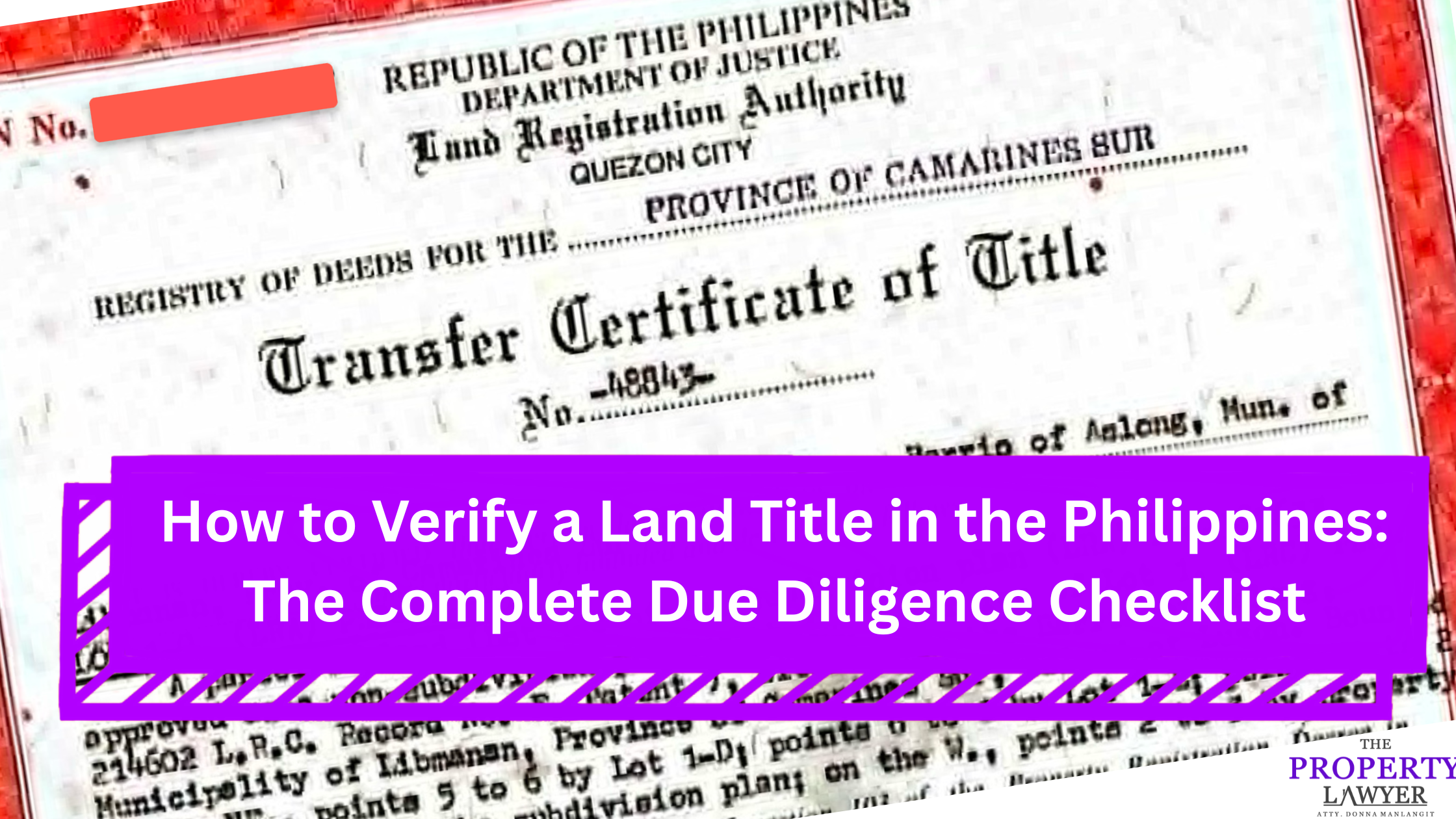
How to Verify a Land Title in the Philippines Before You Pay Written by Atty. Donna Manlangit-Mattingley, Philippine lawyer and licensed real estate broker Say you’re a nurse in Riyadh, and a seller in Bulacan sends you clear photos of a land title. The price looks fair, the seller is friendly, and you’ve been saving for this lot through long shifts, overtime, and years away from the people you love. It’s natural to want to say yes. Photos can’t tell you much. A title that looks right on a phone screen can still disagree with the official record at the Registry of Deeds, and a well-made fake can look just as convincing as the real one. This guide is written for buyers like you, including Overseas Filipino Workers (OFWs) who can’t walk into the Registry of Deeds themselves. It covers 5 checks, from requesting a Certified True Copy from the Registry of Deeds to inspecting the land, and it explains each one in plain language so you know what to ask for. Let’s go through them together. Quick Summary: How to Verify a Land Title in the Philippines To verify a land title in the Philippines, ask the Registry of Deeds for a Certified True Copy (CTC) and compare it with the seller’s Owner’s Duplicate Copy, the tax records, and the land itself. Do these before you pay: The CTC shows the title as the Registry of Deeds holds it, and that official record counts when it disagrees with the seller’s paper. The back page of the CTC lists mortgages, adverse claims, notices of levy, and lis pendens (pending court cases), and each one can block a sale. A tax declaration should match the title but can’t replace it, because the Supreme Court has held that it isn’t conclusive evidence of ownership. A seller acting for the owner needs a notarized Special Power of Attorney (SPA) signed by the registered owner. Not sure what your documents say? Book a consultation and have a lawyer read them before you pay. Why the Paper Title in Your Hand Isn’t Enough A Transfer Certificate of Title (TCT) covers land, and a Condominium Certificate of Title (CCT) covers a condo unit. Each title exists in 2 versions: the registry copy that the Registry of Deeds keeps in its files, and the Owner’s Duplicate Copy that the registered owner holds. The goal is to confirm they match. The paper deserves a look too. Authentic titles are printed on security paper, and holding the sheet against light should reveal a faint watermark of the Land Registration Authority (LRA) printed into the paper itself. Forgers can copy how a title looks and feels, so the watermark is a helpful clue, and the registry check is what settles the question. Documents You Need to Verify a Land Title Four documents do most of the work. Have the title number and the registered owner’s name ready, because each office searches its records by those details before it releases a certified copy to anyone. Document Where to Get It What It Confirms Certified True Copy (CTC) of the title Registry of Deeds The official record of the owner, the boundaries, and active annotations Tax declaration City or Municipal Assessor’s Office How the lot is valued and mapped for tax purposes Real property tax clearance Local Treasurer’s Office Whether real property taxes are paid Special Power of Attorney (SPA) Signed by the registered owner before a notary public A representative’s authority to sign for the owner Due Diligence Checklist to Verify a Land Title in the Philippines 1. Request a Certified True Copy (CTC) of the Title Ask the Registry of Deeds that covers the property for a CTC, then compare the lot number, boundaries, and owner’s name against the seller’s Owner’s Duplicate Copy line by line. Don’t rush this part. If anything doesn’t match, pause and ask the seller to explain. For a condo unit, request the CTC of the CCT. 2. Read the Annotations on the Back Page The back page of the CTC shows the annotations, which are notes about anything already attached to the property. Look for mortgages, adverse claims, notices of levy, and any lis pendens, the formal notice of a pending court case on the property. Don’t let the terms scare you. Each one can stop or complicate a transfer, so ask the seller to clear it before any money moves and to confirm the clearance in writing. 3. Match the Tax Declaration and Tax Clearance to the Title Request a certified copy of the tax declaration from the City or Municipal Assessor’s Office, and a real property tax clearance from the Local Treasurer’s Office. The clearance is your proof that the amilyar, or real property tax, has been paid. The owner’s name and the property description on the tax declaration should also match the title. Small differences matter. A tax declaration supports a title but can’t replace one. It’s an easy mix-up. The Supreme Court has held that tax declarations and tax receipts alone aren’t conclusive evidence of ownership, and that a registered title prevails over them, in Heirs of Delfin v. Rabadon (G.R. No. 165014). Property Lawyer Tip: If a seller offers only a tax declaration, and there’s no title to verify yet, pause and ask why. 4. Confirm the Seller’s Identity and Authority Check the seller’s government-issued ID against the name on the title. When an agent, broker, or relative signs for the owner, ask for a notarized Special Power of Attorney (SPA) signed by the registered owner that names the property and grants the power to sell. An SPA doesn’t transfer ownership. The place of signing matters too. An SPA signed abroad must be apostilled or consularized before it can be registered, according to LRA Circular No. 09-2020, which lists the documents needed to register an SPA on registered land. If the registered owner has passed away, the heirs need to settle the estate before anyone can sell. 5. Inspect

Lawyer or Attorney in the Philippines? The Distinction That Actually Matters for Your Property
Lawyer or Attorney in the Philippines? The Distinction That Actually Matters for Your Property Written by Atty. Donna Manlangit-Mattingley, Philippine lawyer and licensed real estate broker There is no legal difference between a lawyer and an attorney in the Philippines. Once someone finishes law school, passes the Bar, takes their oath, and signs the Roll of Attorneys before the Supreme Court, the two words describe the same person. “Lawyer” names the profession. “Attorney,” usually shortened to Atty., is the courtesy title you’ll see on contracts, court filings, and business cards. Naming the two words as identical is the easy part. The distinction that actually costs people money is a different one, and it has nothing to do with vocabulary. It’s the gap between an attorney-at-law and an attorney-in-fact. Quick Summary: Lawyer vs Attorney in the Philippines A lawyer and an attorney are the same license in the Philippines. There’s no legal difference between the two words. An attorney-in-fact is something else entirely: anyone you appoint through a notarized Special Power of Attorney (SPA) to act on your behalf. Selling or mortgaging property through someone else requires an SPA under Article 1878 of the Civil Code. Only a licensed attorney-at-law, listed on the Supreme Court’s Roll of Attorneys, can review your SPA, verify your title, or represent you in court. Not sure which one your situation needs? Book a consultation with a property lawyer before you sign anything. There Is No Legal Difference Between a Lawyer and an Attorney If you’ve searched this question, you’re probably not confused about grammar. You’ve seen “attorney” used somewhere in a property document and you want to know whether that means the same thing as “lawyer,” or whether you’re missing something. In the Philippines, you’re not. Both words point to a licensed member of the Integrated Bar of the Philippines, full stop. Where people get confused is a second, unrelated use of the word “attorney” that shows up constantly in real estate: the Attorney-in-Fact. Why Attorney-at-Law and Attorney-in-Fact Aren’t the Same An attorney-at-law is a lawyer. An attorney-in-fact is not. It’s a role, not a license, and it belongs to anyone you formally appoint through a Special Power of Attorney, or SPA, to act on your behalf. Your attorney-in-fact can be your sister, your uncle, a trusted friend. No law degree required. Attorney-at-Law Attorney-in-Fact Who they are A licensed lawyer, listed on the Roll of Attorneys Anyone you appoint through a notarized SPA What they can do Review or draft the Deed of Absolute Sale, verify title history, represent you in court over a dispute or reconstitution Sign documents, sell or lease property, collect rent, act on your behalf while you’re unavailable What they can’t do Sign a sale on your behalf without an SPA naming them Give you legal advice, represent you in court, catch a defective title clause The two roles solve different problems, one handles legal risk and the other covers your physical absence. Why This Confuses So Many OFWs and Filipinos Abroad If you learned your legal vocabulary partly from US media, this confusion makes sense. In the United States, someone can graduate from law school and be called a lawyer without ever passing the bar. An attorney, over there, is specifically someone who’s passed it and can practice. This gap between graduating and passing the bar doesn’t exist here. If someone offers to “help with your property case” but isn’t listed on the Supreme Court’s Roll of Attorneys, they can’t sign as your counsel. They can’t represent you in court either, regardless of what they call themselves. This matters more than it sounds like it should, especially for OFWs handling a sale or a transfer from overseas. The person you need to sign paperwork on your behalf, your attorney-in-fact, is not automatically qualified to also catch a legal problem before it costs you the property. Those are two different appointments, and treating them as one is how title problems slip through. What This Means When Buying, Selling, or Settling a Philippine Estate Say you’re working in Dubai and you need to sell a lot back in Batangas. You don’t hire a lawyer to stand in as the seller. Under Article 1878 of the Civil Code, transmitting or mortgaging real property on someone else’s behalf requires a Special Power of Attorney specifically authorizing it. So you appoint a relative you trust as your attorney-in-fact, in writing, notarized, naming exactly what they’re allowed to do. A lawyer reviews the SPA before you sign it, so the person you’ve trusted can’t quietly overstep what you authorized. A lawyer also checks the title itself and traces its history far enough back to catch a defect that never shows up on the current paper. And if a dispute lands in court, the SPA doesn’t help you at all. Only an attorney-at-law can appear for you there. The same split applies to inheritance. Settling an estate often means one heir acts as attorney-in-fact for the siblings still abroad, while a lawyer handles the Extrajudicial Settlement itself and confirms the estate tax obligations are actually cleared. Do You Need a Lawyer or an Attorney-in-Fact? If you’re appointing someone to act while you’re away, that’s an SPA and an attorney-in-fact. If you’re checking a title, reviewing a contract, or dealing with a dispute, that’s a lawyer. Book a consultation with The Property Lawyer and get a straight answer on which one your situation actually needs, before you sign anything. Share this article Facebook Messenger Viber WhatsApp LinkedIn Copy link About the Author I’m Atty. Donna Manlangit-Mattingley, a Philippine lawyer and licensed real estate broker. I help Filipinos and OFWs abroad get smart with their real estate investments in the Philippines. More about meLinkedInFacebookInstagramYouTube

Save Thousands of Pesos With These Property Inspection Tips
Save Thousands of Pesos With These Property Inspection Tips Written by Atty. Donna Manlangit-Mattingley, Philippine lawyer and licensed real estate broker Quick Summary: Property Inspection Tips Before Buying in the Philippines A proper property inspection in the Philippines covers three things, not one: The physical structure: Monsoon rains, typhoons, and constant humidity mean these aspects carry more weight here than in most countries The legal paperwork: Titles, tax clearances, and liens that protect you from problems no walkthrough will ever show you The land itself: Its actual size, boundaries, and classification, none of which a title alone will confirm This guide focuses on house-and-lot and land purchases, with a full condo turnover checklist coming in a separate guide. Before you close a deal, The Property Lawyer can help you verify what a walkthrough alone can’t. A few years ago, I was in Switzerland learning to ski when I started seriously looking at a property back home in Palawan. The listing looked clean. The title was there, the price was fair, and the seller seemed straightforward. I couldn’t fly back to walk the land myself. This is the exact position a lot of my clients are in too, watching a property from thousands of miles away, trying to decide if it’s safe to say yes. So I hired an independent geodetic engineer to check it for me before I committed to anything. What he found changed my decision completely. The land was titled, yes, but only part of it was actually alienable and disposable. The rest was still classified as forest land, meaning I couldn’t legally own or build on it, no matter what the title on paper suggested. A physical walkthrough would never have caught that. Neither would checking the title alone. Most inspection guides miss this exact lesson. Checking the house and checking the paperwork isn’t enough. You need to check the land itself too. Why Property Inspections in the Philippines Need Their Own Checklist Generic inspection advice assumes a climate most of the Philippines doesn’t have. Monsoon season brings months of sustained rain. The country also gets hit with a lot of typhoons that can affect the real structural force. All throughout the humidity stays high enough year-round to hide water damage until it’s already spread. A checklist built for a drier climate misses exactly the problems Philippine buyers run into most. This is why the checks below go further than “look at the walls.” Structural and Water Damage Checks for Philippine Properties Roof and Ceiling Inspection Tips Look closely at the ceiling boards for faint yellowing, bubbling, or dark watermarks, all signs of an active roof leak. Most Philippine homes use corrugated metal roofing rather than shingles. So check the flashing for rust or loose sections, since that’s usually where a leak starts first. Drainage, Elevation, and Flood Risk Checks Entryways and exterior doors should sit on a concrete platform slightly raised above the surrounding ground. It keeps rainwater from seeping indoors during a downpour. Walk the perimeter and confirm the ground slopes away from the foundation, not toward it. Gutters and drainage channels are clear and actually draining into the subdivision’s system. If you can time a visit during or right after heavy rain, do it. A dry-day walkthrough won’t show you what the street does during a real downpour. So ask the neighbors, or check local flood maps, if timing it yourself isn’t possible. Wall Cracks and Flooring Issues to Watch For Hairline cracks are normal as concrete cures and usually nothing to worry about. A crack that cuts all the way through a wall, visible from both the inside and outside, is a different story. It’s worth having a structural engineer look at it before you proceed. Walk the floors too. Uneven tiles or a hollow sound when you tap them, locally known as buhos or kapak, usually means the flooring underneath wasn’t laid properly. Utility and Systems Checks Before You Buy Water Pressure and Drainage Test Turn on every faucet and shower at the same time and see how the pressure holds up. Flush each toilet more than once, and check under the sinks with a flashlight for slow drips, mold, or a damp smell that never made it into the listing. Electrical Safety Checks Find the breaker panel and confirm it’s properly enclosed. Then test every switch and outlet in the house, not just the ones in the main rooms. A cheap outlet tester, or even just a phone charger, is enough to confirm a socket is actually live and wired correctly. Legal and Document Verification Before You Buy Title Authenticity: TCT vs. CCT A house and lot uses a Transfer Certificate of Title (TCT), while a condo unit uses a Condominium Certificate of Title (CCT). Either way, get a Certified True Copy directly from the Registry of Deeds, not a photocopy the seller hands you, and confirm the seller’s name on it matches exactly. Check the annotations too. An active mortgage or lien on the title can become your problem the moment you sign. Tax Clearance and Amilyar Payments Ask for the latest Real Property Tax (RPT) Clearance, proof that amilyar, the property tax Filipinos pay to the local government, has actually been settled. Buy a property with unpaid RPT, and that obligation doesn’t disappear. It usually becomes yours. Why You Need an Independent Geodetic Engineer This is the step my Palawan story came from, and it’s the one buyers skip most often, usually because it feels optional once the title already looks fine on paper. https://www.youtube.com/watch?v=ziISZGc59Tw Watch me walk through exactly what happened with the Palawan property in the video above, then keep reading for what to check and who to hire. Verifying the Actual Size of the Property Even a titled property can carry a size discrepancy. At ₱5,000 per square meter, a gap of just 10 square meters is real money. And the only way to catch it is to have a licensed geodetic engineer survey the

Zoning Classification in the Philippines
Zoning Classification in the Philippines: What Your Zone Code Actually Allows Written by Atty. Donna Manlangit-Mattingley, Philippine lawyer and licensed real estate broker I’ve seen this happen more than once. A buyer finally saves up enough for a piece of land in Cavite, planning to start a small piggery business once the sale pushes through. Everything about the lot seems right, the price, the location, even the neighbors who already raise animals of their own. Then the business permit application gets filed, and the local government office denies it. The lot falls under a residential zone, and a piggery isn’t allowed there under the local ordinance, something the city hall staff usually won’t explain in much detail. It’s the exact mismatch zoning laws exist to prevent, and it catches a surprising number of first-time buyers off guard. Prefer to watch it explained first? Atty. Donna walks through the zoning basics in the video below. This guide then goes further, into every zone code, FAR and PSO limit, and the exact steps to verify your own lot. https://youtu.be/pEHE6g-BSPA Quick Summary: Zoning Classification in the Philippines Zoning classification determines what you’re legally allowed to build or operate on a piece of land in the Philippines. Local government units set this through a Zoning Ordinance, guided by the Comprehensive Land Use Plan, Rule VII of the National Building Code (PD 1096), and the national guidelines issued by the Department of Human Settlements and Urban Development (DHSUD). There are six broad zones: residential, commercial, industrial, agricultural, institutional, and special, and each one splits further into specific codes, such as R-1 to R-5 for residential zoning and C-1 to C-3 for commercial zoning, each carrying its own height and density limit. Before you buy or build, The Property Lawyer can confirm your lot’s actual zone code and what it allows you to do with it. Land Use and Zoning Ordinance in the Philippines The national government decides the broad categories first, classifying land as either alienable and disposable, or as part of the public domain. Your city or municipality then narrows this down through its own Zoning Ordinance, aligned with its Comprehensive Land Use Plan and Rule VII of the National Building Code (PD 1096), on top of the national guidelines set by the Department of Human Settlements and Urban Development (DHSUD). There’s a clear order to how this works. The national government sets the broad classification first, your city or municipality builds its local Zoning Ordinance on top of that, and your lot’s specific zone code comes last, once both levels are already in place. Buyers who skip straight to “what can I build here” without understanding that sequence are usually the ones facing a rejected permit later on. Residential Zoning Classification in the Philippines: R-1 to R-5 Residential zoning in the Philippines isn’t just one category. It splits into five classifications, R-1 through R-5 (sometimes written without the hyphen as R1 to R5), each with its own height and density limit. Code What It Allows Height / Density R-1 Low density, single-detached homes only Low-rise, single family R-2 Single-attached units, duplexes, low-rise multi-family 1–5 storeys R-3 Row houses, medium-rise apartments and condos 1–12 storeys R-4 Low-rise townhouses on subdivided lots Low-rise only R-5 High-density, high-rise condominiums Above 5 storeys, city-defined ceiling R-2 is worth a closer look since it’s one of the classifications buyers ask about most. It’s a bit more flexible than R-1, permitting duplexes and low-rise multi-family buildings up to five storeys. Let’s say you’re eyeing a lot zoned R-1 in a quiet subdivision in Quezon City, with plans to eventually build a mid-rise condominium once the neighborhood grows. It sounds like a reasonable long-term plan, until you bring those building plans to the local planning office and learn that R-1 only permits single-detached homes. This kind of mismatch tends to surface at that stage, often well after the property has already been purchased. Commercial Zoning Classifications in the Philippines: C-1 to C-3 Commercial zoning scales according to the size and intensity of the business activity it’s meant to support. C-1 (Light Commercial): Neighborhood shops and small offices, usually one to three storeys, common in residential-adjacent areas like small subdivisions in Cavite or Laguna. C-2 (Medium Commercial): City-level shopping centers and mid-rise offices, up to five storeys. C-3 (Metropolitan Commercial): Large malls, financial hubs, and high-rise corporate towers, the kind found in business districts like Makati or Bonifacio Global City. A sari-sari store expansion and a full mall development clearly don’t belong under the same code, and the storey limit is usually the quickest way to tell which one applies. Industrial Zoning Classifications in the Philippines: I-1 to I-3 Industrial zoning separates businesses according to how much pollution, noise, or hazard they produce, rather than just their physical size. I-1 (Light Industrial): Non-pollutive assembly, packaging, and storage operations. I-2 (Medium Industrial): Pollutive or hazardous manufacturing, subject to regular environmental checks. I-3 (Heavy Industrial): Large-scale plants and heavy manufacturing, the most restricted tier. A business that looks harmless on paper, like a small packaging facility, can still get flagged if it’s operating under the wrong industrial code. Agricultural, Institutional, and Special Zoning in the Philippines Three more categories round out the system. Agricultural zones (AGR) cover farming, fishponds, and livestock, kept off-limits to urban conversion by design. Institutional zones (GI) are reserved for schools, hospitals, and government buildings. Special zones split further into parks and recreation (PRZ) and tourism areas (TSZ), such as parts of Palawan and Batangas, governed by rules built around preserving what makes those areas worth visiting. When a special zone touches a protected coastline or forest, the Department of Environment and Natural Resources (DENR) regulates it too, on top of the local ordinance. Floor Area Ratio (FAR) and Site Occupancy Limits You Should Check Every zone also carries two additional limits worth knowing, the Floor Area Ratio (FAR) and the Percentage of Site Occupancy (PSO). FAR caps the total floor space you’re allowed to build relative to