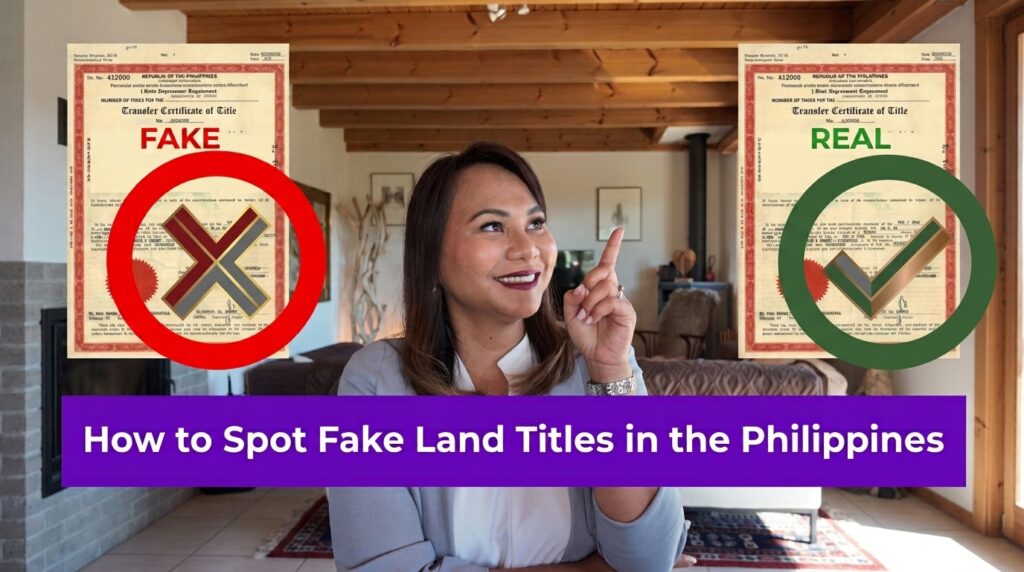
A fake title can look flawless. Fake land titles in the Philippines can imitate a real Transfer Certificate of Title (TCT) so closely that a buyer who only studies the document, a photocopy, or a scan can’t tell the difference.
Under the Torrens system, the country’s land registration system, a forged title gives its holder no ownership, so the buyer who paid for it can end up with nothing.
I’ve seen this happen more than once.
As a licensed lawyer and real estate broker, I hear from heirs and overseas buyers who found out too late, so these are the 3 red flags I’d check first.
Everything starts with the Registry of Deeds. A fake land title is any forged or altered Original Certificate of Title (OCT), Transfer Certificate of Title (TCT), or Condominium Certificate of Title (CCT) whose details differ from the record kept there.
I know it’s tempting to compare your title against a sample or a free PDF. Don’t. A fake land title sample or a free PDF shows only what forgers already copy, so the one comparison that counts is against the Registry of Deeds record.
Say you’re a nurse in Dubai. Your late lolo left the family a farm lot that nobody ever transferred out of his name, and the real property tax went unpaid for years while you worked abroad. Then a cousin appears with a title for the same lot in his own name. Your stomach drops.
Here’s what I’d do first.
Ask the Registry of Deeds where the lot is located for a Certified True Copy (CTC), then compare the registered owner, the title number, and the technical description against the document you were shown. A title in a seller’s hand, or a relative’s, proves nothing until the Registry confirms it.
Watch how the seller reacts. Sellers who make excuses, delay giving the title number, or discourage a trip to the Registry of Deeds are warning you, and so are demands for a reservation fee before any background check. A price far below the market, offered for a fast cash sale, completes the pattern.
Two outcomes are possible. In the Dubai scenario, a missing title means the cousin holds a forgery, while a registered title in his name means the family must find out how the transfer happened.
Imagine you and your husband live in Italy and lend your original Deed of Sale to a barangay acquaintance who says she needs it as a reference for her own title application.
Then she goes silent. Your original deed is still with her.
Ask who is acting for the owner. When an agent or relative handles a sale, the registered owner must have signed a Special Power of Attorney (SPA) that names that person and the task.
Under Article 1878 of the Civil Code, selling or mortgaging real property for someone else requires an SPA, and an SPA lets a person act for the owner but never transfers ownership.
I break down who can sign for you in my lawyer vs attorney guide. Raw land offered on a tax declaration alone, with no title certificate behind it, is the same warning.
For you in Italy, the first move is a fresh CTC of the lot, which shows whether anyone has filed a new annotation or claim against it.
Registering a transfer requires both the owner’s duplicate certificate of title and the deed, so a deed alone doesn’t complete a transfer.
Hand out copies, keep originals.
Image source: Land Registration Philippines
Say you’re an electrician in Qatar. You buy a 2,000-square-meter lot and register the title in your name, and 7 years later a woman arrives with an older title and claims it covers your lot. She’s already listing it for sale.
Don’t stop at the current title. I tell buyers to trace back at least 3 previous titles before they complete the sale, because broken ownership chains and hidden claims can go unnoticed on the latest title.
A trace back follows the title through each earlier owner, which is how a conflicting older title can turn up before you pay instead of after.
For you in Qatar, the first moves are a fresh CTC of your own title and a trace back of the older title the woman holds. Then bring both documents to a lawyer.
Run every check yourself. Please don’t rely on photocopies, scans, or certified true copies the seller hands over, because forgers can replicate them and only a copy you request yourself comes straight from the Registry of Deeds.
If you’ve already paid for a title you now doubt, take a breath. You have options. On the criminal side, you can file complaints for falsification of public documents and estafa under the Revised Penal Code against the people behind the forgery.
On the civil side, an action for reconveyance asks the court to return the property to its rightful owner. Other civil options are a petition to annul the fake title and the deed of sale behind it, and a claim for damages against the seller.
One exception helps buyers. Under the innocent purchaser for value rule, a buyer who paid full price and registered the property in good faith, with no notice of any flaw in the title, keeps the property.
A buyer who skipped basic checks can lose the exception, so I always say verification comes first.
Deadlines apply too. Philippine law sets prescription periods for many property disputes, and how long you have depends on the type of claim, so please don’t wait on a title you suspect is fake.
Let’s look at it together. If you’re unsure about a title, or a seller is pushing you to pay fast, bring whatever documents you have and I’ll go through them with you.